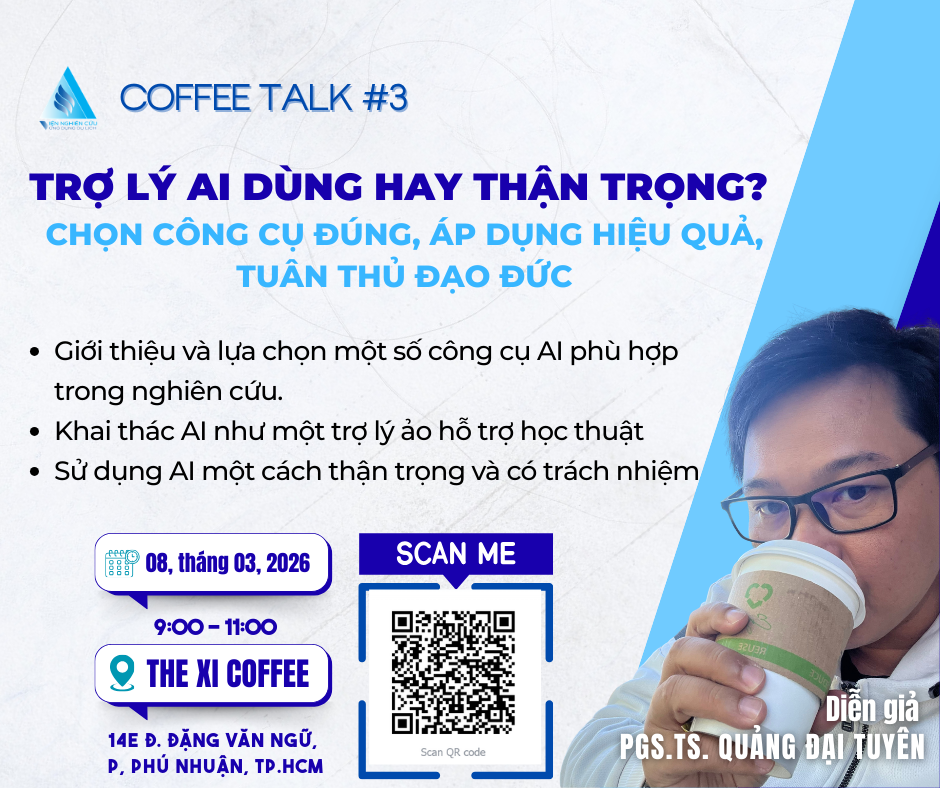

As AI is becoming increasingly integrated into learning and research, the use of writing-support tools has emerged as a topic of growing interest. Through Coffee Talk #4, the Research Institute for Applied Tourism hopes to create a modest and collegial space for academic exchange, where participants may reflect more carefully on the role, limits, and implications of AI as it becomes more deeply involved in academic writing practices.
Coffee Talk #4 discusses AI-assisted academic writing, the limits of “humanizing” tools, and how AI may be used in a careful and responsible manner in scholarly work.
AI in academic writing: greater convenience, but also growing questions
In recent years, AI-assisted writing tools have become increasingly common in academic settings. From idea generation and language support to structural suggestions and stylistic refinement, AI is gradually becoming a familiar aid for many students and researchers.
At the same time, however, this growing convenience has also brought with it a number of important concerns. In particular, some tools are now promoted as being able to “humanize” text, making it appear more like human writing and, in some cases, less likely to be identified as AI-assisted. This development raises difficult questions about the boundary between technical support and academic integrity.
Against this backdrop, Coffee Talk #4 is being organized as an open forum for discussion, with the hope of encouraging a calm, thoughtful, and responsible reflection on these issues.

A modest topic of discussion, yet by no means a simple one
With the theme “AI Tools Marketed as ‘100% Undetectable’? Humanizing Writing into Academic Journal-Style Prose,” the program seeks to open discussion around several questions that are currently attracting considerable attention.
First, as AI becomes increasingly capable of assisting with writing, what might constitute an appropriate boundary between using a tool to improve expression and allowing that tool to shape the substance of academic work too deeply? This is not merely a technical question; it also concerns the writer’s responsibility for argumentation, evidence, and scholarly voice.
In addition, so-called text-humanizing tools prompt another question that deserves careful consideration: is the purpose of such revision to improve the quality of expression, or does it risk shifting toward concealing the traces of AI assistance? Once this boundary becomes less clear, the issue is no longer simply about writing more fluently, but about writing in a manner that remains transparent and ethically grounded.
Another issue that also deserves attention is the psychological pressure many people experience when their writing is subjected to AI-detection tools. For many students and writers, being suspected of “using AI” can sometimes create feelings of stress, anxiety, and reduced confidence, even when they are the ones who directly developed and refined the content themselves. For that reason, discussing AI in academic work is not only a discussion about technology, but also one about fairness, transparency, and the writer’s academic experience.
From this perspective, Coffee Talk #4 does not aim to offer definitive conclusions. Rather, it hopes to provide an opportunity for participants to share views, experiences, and practical concerns related to the use of AI in learning, teaching, and research.
Reflecting on how AI may be used more appropriately
One of the central orientations of the program is to approach AI as a tool that requires thoughtful and discerning use. In many cases, AI may help writers save time, broaden possibilities, and improve clarity of expression. Even so, the core of academic writing still depends on the researcher’s own capacity to define the problem, construct arguments, select evidence, and take responsibility for the claims being made.
For that reason, the more important question may not be whether AI should be used at all, but rather to what extent, at which stages, and with what sense of responsibility. This is also one of the key issues the program hopes to explore further with participants in a setting that is informal and approachable, while still maintaining the academic seriousness the topic requires.
Speaker
The session will feature Associate Professor Quang Dai Tuyen, PhD, Faculty of Tourism, Van Lang University.
Through the speaker’s sharing and discussion, Coffee Talk #4 hopes to contribute a practical yet cautious perspective on the use of AI in academic writing, particularly at a time when students and researchers are engaging more frequently with AI-based writing tools.
Event information
Program Information
Time: 09:00–11:00, 18 April 2026
Venue: The Xi Coffee, 14E Dang Van Ngu Street, Ward 10, Phu Nhuan District, Ho Chi Minh City
The Research Institute for Applied Tourism respectfully invites lecturers, graduate students, doctoral researchers, undergraduates, and all those interested in this topic to join Coffee Talk #4.
It is hoped that, through what may appear to be a small conversation, participants will have an additional opportunity to reflect more seriously on how AI may be used in academic work in ways that are useful, appropriate, and responsible.